Legal briefing | |

Trade Union Access Rights

Overview

From 30 October 2026, trade unions will have the right to formally request access to workplaces to meet, support, represent, recruit or organise workers and to facilitate collective bargaining. This is one of a number of measures which the Government is introducing with a view to increasing trade union engagement, and the Government has committed to reviewing this new statutory access right within the first six months, so it is possible that changes will be made in the future.

This briefing looks at key features of the new right and how employers can prepare.

Which employers will this apply to?

A trade union can only make a statutory access request to an employer which has 21 or more workers in total (this threshold applies across the employer and its group companies). Agency workers are only included in the calculation if they do not have a contract of employment with the agency which supplies them.

The new right applies regardless of whether the employer recognises a union and even if no workers are trade union members (although in practice trade unions may be more likely to approach employers with at least some trade union members in the workforce).

How does a trade union make a request?

A trade union can choose to make an informal request for access, or a statutory request for access in line with the Code of Practice (see below). The Code of Practice strongly encourages both sides to try to reach a voluntary agreement before using the statutory process. Any voluntary agreement which is reached without the trade union having made a statutory access request will fall outside the statutory process, and the parties are free to agree any access arrangements they like. In practice though, it is likely that the trade union would seek access arrangements in line with the statutory model terms (see below).

Although the parties are encouraged to reach voluntary agreement, a trade union can go straight to making a statutory access request if it chooses. If the union makes a statutory request, then there will be a process for negotiation (see below), which is set out in a Code of Practice.

A statutory access request must be in writing and contain certain information including the purpose of access, the workers who will be covered, the type of access (physical, digital or both) and the frequency of visits.

What happens after a trade union makes a statutory access request?

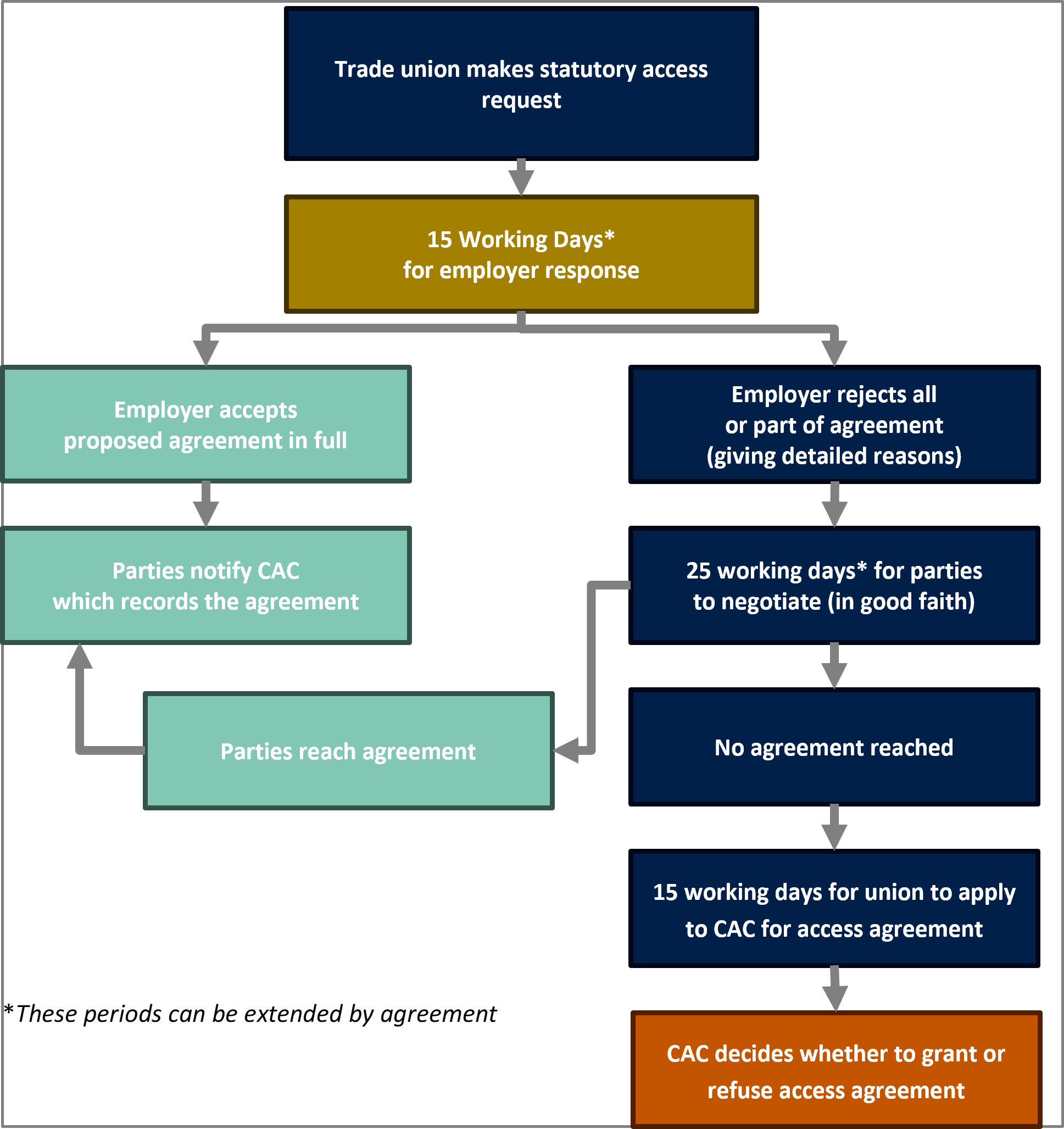
After a statutory access request is made, there is a timetable and process for seeking to reach a statutory access agreement, and for applying to the Central Arbitration Committee (CAC) if negotiations fail. This is summarised in the flowchart below:  

Trading Law

The starting presumption is that the CAC will  grant an access agreement as long as it does not unreasonably interfere with the employer's business. When reaching its decision, the CAC will consider whether the agreement requested by the trade union reflects the CAC's model terms for an access agreement. The model terms are:

  • Trade union access visits up to once a week

  • Employer to make accommodation and facilities reasonably available

  • Trade union to give notice of

    • at least five working days before first access visit
    • at least two working days for all subsequent access visits

  • Employer to ensure privacy of communications between workers and union

If the trade union presents the CAC with an access agreement which reflects the model terms, does not last longer than two years, and no other trade union has (or is seeking) recognition or access, then the CAC is highly likely to grant the access agreement, unless the employer can show that the access would unreasonably interfere with its business.

What would a statutory access agreement mean in practice?

This will partly depend on what is contained in the agreement. However, the Code of Practice makes various recommendations as to how an access agreement should operate including that:

  • Access meetings should take place at the workplace in meeting rooms or break areas

  • Meetings should take place within normal working hours, at times that minimise disruption (such as towards the end of a shift or in a rest period)

  • Workers should be paid in full if attending meetings in work time and their work should not be organised so that they are prevented from attending meetings

  • Employers must respect the privacy of access meetings and should not attend, monitor or record any meetings (physical or digital)

Trade unions can request digital access alongside or instead of physical access. Digital access can operate in different ways, for example the employer cascading union communications on behalf of the union or facilitating an online meeting between the trade union and workers.

We have some workers who work at third party sites (e.g. client sites). Could they be covered by an access request or agreement?

Yes, and the Code of Practice addresses this scenario. Where an employer has workers based at a third party's premises, the employer should take reasonable steps to try to arrange access with the owner of the premises. If this fails then the employer or trade union can apply to the CAC which could choose to impose access covering the third party's premises (and the enforcement framework referred to below would apply).

Similarly, if an employer has a third party's workers on its site, for example security staff supplied by a contractor, the third party may receive an access request in respect of those workers. If so, the employer should engage with the third party as to how the trade union may access those third party's workers at its premises.

How would we terminate a statutory access agreement?

The access agreement will state how long it lasts for, which will usually be two years (although the parties could agree to extend). The agreement can only be ended early by agreement (neither party can act unilaterally). If both sides agree to bring the agreement to an end early (or make any other change to the agreement) they must jointly notify the CAC.

What are the consequences of breaching a statutory access agreement?

The Code of Practice encourages parties to seek to resolve access disputes through dialogue and use any dispute resolution mechanism in the access agreement. If this fails, either party can apply to the CAC within three months of the breach. The CAC may then uphold or reject the complaint, alter the agreement, and/or order specific steps to remedy the breach.

If a party either (i) breaches a CAC order or (ii) breaches the agreement again within 12 months, the CAC can then make a further determination and/or impose financial penalties. The penalty scale is:

  • First penalty order: up to £75,000.
  • Second penalty order (relating to same access agreement): up to £150,000.
  • Third and subsequent orders: up to £500,000 each.

Where an agreement covers multiple sites, the penalties are cumulative across sites. For example, if there have been two breaches at different sites and then there is a third breach at another site, the maximum £500,000 penalty could be ordered for the third breach. There is also no limit to the number of £500,000 fines for third and subsequent breaches.

When deciding the penalty, the CAC must consider various factors including the gravity and duration of the breach; whether it was deliberate or negligent; the number of workers affected; the size and resources of the liable party; and any history of non-compliance. Decisions of the CAC (including penalty orders) may be appealed to the Employment Appeal Tribunal (EAT), which may cancel, reduce, or uphold the penalty.
How should we prepare for receiving an access request?

In preparation for the new rights employers should:

  • Consider whether there is any value in taking pro-active steps to speak to trade unions and seek to agree informal access.

  • Consider setting up an employee forum or other employee listening channels to enable employees to raise any issues or concerns and offer alternatives to trade union recognition.

  • Implement a protocol for receiving and handling an access request, including details of who needs to be informed and who has authority to negotiate

  • Consider making it clear (eg on the website) who any access request should be sent to, to make sure a request is not inadvertently overlooked

  • Ensure the right people within the organisation are aware of the rules and know how to deal with requests

  • Prepare key stakeholders (e.g. parent company, investors, including overseas stakeholders) for the possibility of access requests and what they involve in practice. Contact relevant third parties (i.e. where a third party's workers are based at the employer's site or where any of the employer's own workers are based at a third party's site) to agree how any access requests will be notified and handled

  • Be ready to engage constructively with any access request whether voluntary or statutory (note that if a trade union makes an informal request and a voluntary access agreement is reached, the process will be more flexible, and the statutory penalties will not apply).
Back To Top Back To Top chevron up